Showing posts with label human rights. Show all posts

Wednesday, February 22, 2012

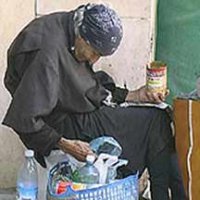
WOMEN AND POVERTY


Women make up half of the world's population and yet represent a staggering 70% of the world's poor. For the millions of women living in poverty, their lives are a litany of injustice, discrimination and obstacles that get in the way of achieving their basic needs of good health, safe childbirth, education and employment. Overcoming these inequalities and ensuring that women benefit from development requires that the needs and desires of women are not only taken into account, but be put front and center.

We live in a world in which women living in poverty face gross inequalities and injustice from birth to death. From poor education to poor nutrition to vulnerable and low pay employment, the sequence of discrimination that a woman may suffer during her entire life is unacceptable but all too common and happens in every country, rich or poor.  What does this look like throughout a woman's life?

As a baby born into poverty, she might be abandoned and left to die, through the practice of female infanticide. Worldwide, there are 32 million missing women'. During her childhood, her proper feeding and nutrition may be neglected out of family favoring of male children.

  As a girl or woman she may be a victim of female genital mutilation and cutting. 100 to 140 million girls and women around the world have undergone genital mutilation, including 6.5 million in Western countries. Embedded in cultural norms, this act is often carried out with the consent of mothers, in conditions that lead to lifelong pain, infection and premature death. As an adolescent she may be required to have an early marriage…and young pregnancy puts girls at risk of maternal deaths.

WomenTeachingWomen is devoted to changing this picture by providing women with the education and skills to start small businesses and become financially independent. 

Tuesday, February 14, 2012

The Realities of Poverty In Israel

THE REALITIES OF POVERTY IN ISRAEL
Before Yael, a haredi woman, landed her job, she and her family of five were eking out an existence on the $475 a month her husband made studying Torah full-time at a yeshiva plus about another $100 from government child allowances. 

Her relatives helped when they could, but the family’s monthly income still left it well beneath the poverty level in Israel. 


Now Yael, who like the other women I interviewed in preparation for WomenTeachingWomen’s upcoming programs in Israel, asked that her real name not be used, is earning about $1,200 a month doing paralegal work at a company that exclusively employs religious women like her. 


She shudders when she recalls the dark days of unemployment and impoverishment. 

She talked about how scary it was not to have the means to shop for basic needs like food and clothes. 

That feeling has become familiar to more and more Israelis who constitute a growing underclass.

In a robust economy that has produced an abundance of millionaires, there are many groups of people who have been left behind.  Among those hardest hit by poverty in the Jewish state are fervently Orthodox Jews (Haredim), new immigrants and Arabs — three groups that despite their obvious differences have much in common socioeconomically. 


All of the women we interviewed expressed a great desire to change their lives by becoming economically self-sufficient.  Most of them had excellent skills that could be used to start a small business.  Business ownership not only gives these women the opportunity to change their financial status, but it also gives them the flexibility to work and care for their typically large families.  These women are motivated and excited to start to the WomenTeachingWomen programs.

Wednesday, August 10, 2011

The Importance of Micro-Finance

     The term micro-finance refers to small loans and other financial and non-financial services  that enable people to start their own small businesses.  These loans and services have been proven to be an effective and sustainable tool in fighting poverty around the world.  The term was first used by Muhammad Yunus who won the Nobel Peace Prize in 2006 for his work using micro-finance in Bangladesh where he successfully helped one million people become financially independent and freed from poverty.  Micro-finance creates empowerment through the creation and maintenance of  sustainable and independent businesses.

     Micro-finance helps by:
  • Offering people who are typically excluded from the traditional banking system access to unique financial and non-financial services
  • Provides the training and services that allows people to create sustainable businesses
  • Demands these business work within a culture based upon strong ethics and business management
Professor Yunus 
     WomenTeachingWomen (WTW) successfully uses these principles all over the world to help people out of poverty  and achieve the vision of self-empowerment and economic independence.  Working with micro-finance and business experts WTW aims to maintain the economic sustainability of the people they work with as they build up their own ventures to become profitable businesses.  Working with the basic philosophy of  helping people to help themselves, WTW helps to strengthen and enable the poor to become independent and productive members of society.